Showing posts with label Wall Street. Show all posts

Saturday, May 8, 2010

The (Almost) Crash of Wall Street


Thursday, May 6, 2010

Ninety minutes before the end of the trading day today, the U.S. stock market almost melted down The Dow Jones Industrial Average dropped nearly 1,000 points. The market regained ground before the end, like a giant 747 narrowly averting a crash landing, but the questions of the day are: What happened? And What does it mean?

At this point no one knows why. Some say it was sudden burst of worries about Greece’s debt and the increasing possibility of a default that might cause a run by global investors. Others point to a “trading error.” Giant high-speed computers generate millions of trade based on instructions embedded in computer programs designed to move fast enough to beat everyone else. So when there’s a glitch in one of them it can immediately spread to all the other programs designed to move just as fast. Some say it was an erroneous trade entered by someone at a big Wall Street bank who mistyped an order to sell a large block of stock, and that the big drop in that stock’s price (Procter & Gamble?) triggered “sell” orders across the market.

Regardless of why it happened, it’s further evidence that the nation’s and the world’s capital markets have become a vast out-of-control casino in which fortunes can be made or lost in an instant — which would be fine except for the fact that most of us have put our life savings there. Pension funds, mutual funds, school endowments — the value of all of this depends on a mechanism that can lose a trillion dollars in minutes without anyone having a clear idea why. So much of the market now depends on computer programs and mathematical models that no one fully understands, so much trading is in the hands of a few people whose fat thumbs or momentary carelessness might sink the economy, so much of global wealth now depends on who can move their money quickest at the slightest provocation — that we are toying with financial disaster every day. The luck or foolishness of a few traders, and inside knowledge and information that some possess and others don’t, combined with ultra high-speed computers, put us all at the whim of a system whose risk is way out of proportion to any public benefits.

The financial reforms being considered on Capitol Hill are steps in the right direction. But the “systemic risk” now embedded in our capital markets is higher than ever, and will require far greater understanding and vigilance than now being considered.


Let The Sun Shine In......

Tuesday, April 20, 2010

Financial Reform Goes Full Tilt

Monday, April 19, 2010

Democrats Call Out GOP Leaders On Wall Street Dealings 

With the Senate planning to begin debate this week on the largest regulatory overhaul of the financial industry since the Great Depression, Democrats are demanding that GOP divulge details of "backroom negotiations" with Wall Street executives.

Advocates of reform, both inside and outside the Senate, are pushing the chamber to adopt the strongest possible measures to regulate banks and financial institutions so as to give consumers the most protection possible.

"With the announcement that the Senate is now scheduled to begin floor debate on a comprehensive financial regulatory reform package this week, we urge Senators to enact real reform to protect Americans and our financial system," says John Morton, managing director of the Pew Economic Policy Group, a division of The Pew Charitable Trusts that promotes policies and practices that strengthen the U.S. economy. "Senators from both sides of the aisle can and should work together to pass a final bill that: creates an early warning system; ends 'Too Big To Fail' and bailouts; increases transparency in markets; and provides meaningful consumer protections. Financial reform must significantly reduce the likelihood of future crises and ensure that, should a crisis occur, the American taxpayer is not left covering the tab."

Sen. Bernie Sanders of Vermont, a left-leaning independent who led an unsuccessful campaign to deny Ben Bernanke a second term at the head of the Federal Reserve, outlined the four provisions that he thinks are needed provisions in a final financial reform bill.

Financial reform is another high priority for President Obama, and the legislation that the Senate will vote on is a package put together by Sen. Chris Dodd (D-Conn.), chairman of the Senate Banking Committee.

“Disgust at Wall Street is profound. The American people want us to change in a very profound way how Wall Street functions, and Congress must deliver,” Sanders says, adding that he would offer amendments to the Dodd bill.

Although Dodd had worked with key GOP senators in crafting his reform bill, including Sen. Richard Shelby of Alabama, the ranking Republican on Banking, no Republicans have thus far been willing to support the Senate bill.

Senate Majority Leader Harry Reid, however, cited public comments by Shelby who has indicated that Republicans could agree on 70 to 80 percent of the Dodd proposal.

“Holding big banks accountable for the enormous economic crisis of recent years is about more than dollars and cents. It is about fairness and justice. It’s also about learning lessons from the mistakes of the past so we are not bound to repeat them,” Reid says in remarks Monday on the Senate floor.

The Senate majority leader also notes that federal regulators last week began legal action against the firm Goldman Sachs for allegedly illegal, fraudulent dealings that contributed to the 2008 financial meltdown.

Reid and his spokesman each called out Senate Republican Leader Mitch McConnell and Sen. John Cornyn (R-Texas) for "secret" meetings with Wall Street executives eager to derail the new reforms. Cornyn is chairman of the Senate GOP campaign operation. Republicans reportedly for months have been seeking campaign contributions from the financial industry in exchange for working to kill the reform legislation.

“Republicans also refuse to admit whose side they’re on,” Reid says. “Earlier this month, the Republican Leader and the head of the Republicans’ Senate campaign committee went to Wall Street. They met with the bankers and hedge-fund managers who benefited more than anyone from the broken system and are trying harder than anyone to stop us from fixing it.”

In a separate statement and citing television news interviews (video), Reid spokesman Jim Manley says McConnell and Cornyn refuse to disclose just what they have said in their talks with bankers behind closed doors. Prior to dissatisfaction due to financial reform, Wall Street executives generally gave more in recent years to Democrats.

“Senators McConnell and Cornyn should immediately reveal what they discussed earlier this month during secret, closed-door meeting with Wall Street executives in New York City,” Manley says. “Years of greed and excess on Wall Street cost 8 million jobs and trillions in wealth for middle-class families and small businesses. Since Republicans appear to be conducting backroom negotiations with these same people who took our economy to the brink of collapse, the public deserves to know what secret deals and carve-outs Republicans are offering Wall Street executives in exchange for their support.”
Let The Sun Shine In......

Should Banksters go to jail

In a word; YES! Jail time is the only thing that will serve as a big stick with these people. That and humongous fines.....like enough to replenish the treasury.

BUZZFLASH DISCUSSION

The fallout from government's civil charges against Goldman Sachs has already begun. Still, it's not clear if this is the beginning of a wider attempt to seriously punish Wall Street for its obvious role in the recession or just a show for politics.

What do you think will happen following the Goldman suit? Will the Obama Administration be encouraged to move forward against the rest of Wall Street, either with charges or regulation? Or will old money prevail in preventing the kind of regulation that would stop this reckless behavior in the future and get any suits against them dropped?
Let us know in the comments below.

Let The Sun Shine In......

Monday, April 19, 2010

Maybe Nationalizing the Banks Isn't such a bad idea

Wasn't Hoover who said that the problem with Capitalism is Capitalists?

Goldman Sachs DC Offices protest

Goldman Sachs was in the spotlight last November when demonstrators protested outside its Washington offices against executive bonuses. Photograph: Andrew Harrer/Bloomberg via Getty Images

The global financial crisis, it is now clear, was caused not just by the bankers' colossal mismanagement. No, it was due also to the new financial complexity offering up the opportunity for widespread, systemic fraud. Friday's announcement that the world's most famous investment bank, Goldman Sachs, is to face civil charges for fraud brought by the American regulator is but the latest of a series of investigations that have been launched, arrests made and charges made against financial institutions around the world. Big Finance in the 21st century turns out to have been Big Fraud. Yet Britain, centre of the world financial system, has not yet levelled charges against any bank; all that we've seen is the allegation of a high-level insider dealing ring which, embarrassingly, involves a banker advising the government. We have to live with the fiction that our banks and bankers are whiter than white, and any attempt to investigate them and their institutions will lead to a mass exodus to the mountains of Switzerland. The politicians of the Labour and Tory party alike are Bambis amid the wolves.

Just consider the roll call beyond Goldman Sachs. In Ireland Sean FitzPatrick, the ex-chair of the Anglo Irish bank was arrested last month and questioned over alleged fraud. In Iceland last week a dossier assembled by its parliament on the Icelandic banks – huge lenders in Britain – was handed to its public prosecution service. A court-appointed examiner found that collapsed investment bank Lehman knowingly manipulated its balance sheet to make it look stronger than it was – accounts originally audited by the British firm Ernst and Young and given the legal green light by the British firm Linklaters. In Switzerland UBS has been defending itself from the US's Inland Revenue Service for allegedly running 17,000 offshore accounts to evade tax. Be sure there are more revelations to come – except in saintly Britain.

Beneath the complexity, the charges are all rooted in the same phenomenon – deception. Somebody, somewhere, was knowingly fooled by banks and bankers – sometimes governments over tax, sometimes regulators and investors over the probity of balance sheets and profits and sometimes, as the Securities and Exchange Commission (SEC) says in Goldman's case, by creating a scheme to enrich one favoured investor at the expense of others – including, via RBS, the British taxpayer. Along the way there is a long list of so-called "entrepreneurs" and "innovators" who were offered loans that should never have been made. Lloyd Blankfein, Goldman's CEO, remarked only semi-ironically that his bank was doing God's work. He must wake up every day bitterly regretting the words ever emerged from his mouth.

For the Goldmans case is in some ways the most damaging. The Icelandic banks, Anglo Irish bank and Lehman were all involved in opaque deals and rank bad lending decisions – but Goldman allegedly went one step further, according to the SEC actively creating a financial instrument that transferred wealth to one favoured client from others less favoured. If the Securities and Exchange Commission's case is proved – and it is aggressively rebutted by Goldman – the charge is that Goldman's vice-president Fabrice Tourre created a dud financial instrument packed with valueless sub- prime mortgages at the instruction of hedge fund client Paulson, sold it to investors knowing it was valueless, and then allowed Paulson to profit from the dud financial instrument. Goldman says the buyers were "among the most sophisticated mortgage investors" in the world. But this is a used car salesman flogging a broken car he's got from some wide-boy pal to some driver who can't get access to the log-book. Except it was lionised as financial innovation.

The investors who bought the collateralised debt obligation (CDO) were not complete innocents. They had asked for the bond to be validated by an independent expert into residential mortgage-backed securities – a company called ACA management. ACA gave the bond the thumbs-up on the understanding from Fabrice Tourre that the hedge fund Paulson were investing in it. But the SEC says Tourre misled them, a pivotal claim that Goldman denies. The reality was that Paulson was frantically buying credit default swaps in the CDO that would go up in price the more valueless it became – a trade that would make more than $1 billion. Worse, Paulson had identified some of the dud sub-prime mortgages that he wanted Tourre to put into the CDO. If the SEC case is true, this was a scam – nothing more, nothing less.

Tourre could see what was coming. In one email in January 2007 he wrote: "More and more leverage in the system. The whole building is about to collapse anytime now… only potential survivor, the fabulous Fab[rice Tourre] .. standing in the middle of all these complex highly leveraged exotic trades he created without necessarily understanding all of the implications of those monstrosities". Fabulous Fab, like his boss, will not be feeling very fab today.

The cases not only have a lot in common – using financial complexity allegedly to deceive and then using so-called independent experts to validate the deception (lawyers, accountants, credit rating agencies, "portfolio selection agents," etc etc ) – but they also show how interconnected the financial system is. In Iceland Citigroup and Deutsche Bank covered the margin calls of distressed Icelandic business borrowers, deepening the crisis. Lehman uses the lightly regulated London markets and two independent British experts to validate that their "Repo 105s" were "genuine" trades and not their own in-house liability. 

The American authorities pursued a Swiss bank over aiding and abetting US nationals to evade tax.

Bankers will complain these cases all involve one or two misguided individuals, but that most banking is above board and was just the victim of irrational exuberance, misguided belief in free market economics and faulty risk management techniques. Obviously that is true – but, sadly, there is much more to the crisis. Andrew Haldane, executive director of the Bank of England, highlights the remarkable reduction in the risk weighting of bank assets between 1997 and 2007. Put simply, Europe's and the US's large banks exploited the weak international agreement on bank capital requirements in the so-called Basel agreement in 2004 to reclassify the risk of their loans and trading instruments. They did not just reduce the risk by 5 or 10%. Breathtakingly, they claimed their new risk management techniques were so wonderful that the riskiness of their assets was up to half of what it had been – despite property and share prices cresting to new all-time highs.

Brutally, the banks knowingly gamed the system to grow their balance sheets ever faster and with even less capital underpinning them in the full knowledge that everything rested on the bogus claim that their lending was now much less risky. That was not all they were doing. As Michael Lewis describes in The Big Short, credit default swaps had been deliberately created as an asset class by the big investment banks to allow hedge funds to speculate against collateralised debt obligations. The banks were gaming the regulators and investors alike – and they knew full well what they were doing. Simon Johnson's 13 Bankers shows how the major American banks deployed vast political lobbying power and money to create the relaxed regulatory environment in which all this could take place. In Britain no money changed hands. Gordon Brown offered light-touch regulation for free – egged on by the Tories, who wanted to go further.

This was the context in which Goldman's Fabulous Fab created the disputed CDOs, Sean FitzPatrick allegedly moved loans between banks and Lehman created its Repo 105s along with the entire "debt mule" structure revealed this weekend of inter-related companies to shuffle debt around its empire. London and New York had become the centre of an international financial system in which the purpose of banking became making money from money – and where the complexity of the "innovations" allowed extensive fraud and deception.

Now it has all collapsed, to be bailed out by western taxpayers. The banks are resisting reform – and want to cling on to the business practices and business model that has so appallingly failed. It is obvious why: it makes them very rich. The politicians tread carefully, only proposing what the bankers say is congruent with their definition of what banking should be. Labour and Tories alike are united in opposing improved EU regulation of hedge funds, buying the propaganda those operations had nothing to do with the crisis. Perhaps Paulson's trades at Goldman, and the hedge funds' appetite for speculating in credit default swaps, may disabuse them.

It is time to reframe the question. Banks and financial institutions should do what economy and society want them to do – support enterprise, direct credit to where it is needed and be part of the system that generates investment and innovation. Andrew Haldane – and the governor of the Bank of England – are right. We need to break up our banks, limit their capacity to speculate and bring them back to earth. Britain should also launch an official investigation into what went wrong – and hand the findings to the Serious Fraud Office. This needs to become this election campaign's number one issue – not one which either a compromised Labour party or a temporising Conservative party will relish. The Lib Dems, the fiercest critics of the banks, have begun to get very lucky.

Crisis timetable

September 2007 Funding problems at Northern Rock triggers the first run on a British bank. It is nationalised in February 2008.

April 2008 Bear Stern faces bankruptcy after a run on the company wipes out cash reserves in less than two days. Backed by the Federal Reserve, JPMorgan buys up shares at far below market value.

September 2008 Lehman Brothers files for bankruptcy protection, becoming the first major bank to collapse since the start of the credit crisis.

December 2008 Bernard Madoff arrested for operating the largest Ponzi scheme in history.

January 2009 The Bank of England launches £200bn quantitative easing.

March 2010 Former chairman of Anglo Irish bank Sean Fitzpatrick is arrested in Dublin after failing to disclose details of loans worth millions from the bank.

April 2010 Northern Rock former directors, David Baker and Richard Barclay, are fined £504,000 and £140,000 for deliberately misleading analysts prior to nationalisation.

April 2010 The US Securities and Exchange Commission accuses Goldman Sachs of "defrauding investors by misstating and omitting key facts".

Joanna Aniel Bidar
• This article was amended on Monday 19 April. A reference to Anglo Irish looking after the Post Office's financial services was removed. Bank of Ireland is the Post Office's financial services provider.
Let The Sun Shine In......

Sunday, April 18, 2010

Tears From The Greedy On Wall Street

Can The Teabaggers figure out who the real enemies are? We'll see when financial reform hits the chambers and the airwaves. Can the GOP convince them that the Democratic Bill is the opposite of what it really is? 

BILL MOYERS AND MICHAEL WINSHIP

With all due respect, we can only wish those Tea Party activists who gathered in Washington and other cities this week weren’t so single-minded about just who’s responsible for all their troubles, real and imagined. They’re up in arms, so to speak, against Big Government, especially the Obama administration.
If they thought this through, they’d be joining forces with other grassroots Americans who in the coming weeks will be demonstrating in Washington and other cities against High Finance, taking on Wall Street and the country’s biggest banks.

The original Tea Party, remember, wasn’t directed just against the British redcoats. Colonial patriots also took aim at the East India Company. That was the joint-stock enterprise originally chartered by the first Queen Elizabeth. Over the years, the government granted them special rights and privileges, which the owners turned into a monopoly over trade, including tea.


It may seem a bit of a stretch from tea to credit default swaps, but the principle is the same:when enormous private wealth goes unchecked, regular folks get hurt -- badly. That’s what happened in 2008 when the monied interests led us up the garden path to the great collapse.


So the Tea Party crowd should be demanding accountability from Bank of America, Citigroup, Goldman Sachs, JPMorgan Chase, Morgan Stanley, Wells Fargo, and scores of hedge funds and private equity firms that constitute what we loosely call Wall Street.


But are the culprits taking responsibility for devastating the lives of millions of ordinary Americans? Don’t kid yourself. If you’ve been watching them appear before congressional committees and the Financial Crisis Inquiry Commission -- the independent inquiry that’s supposed to find out what really happened -- you’ve no doubt been reaching for the Pepto-Bismol.


Here’s Robert Rubin, former Treasury Secretary and director of Citigroup, testifying last week. "Almost all of us involved in the financial system, including financial firms, regulators, ratings agencies, analysts and commentators missed the powerful combination of forces at work and the serious possibility of a massive crisis," he said. "We all bear responsibility for not recognizing this, and I deeply regret that."


Okay, maybe you didn’t have a crystal ball. But what about good, old-fashioned business sense? How could you make so much money and not know the score? "You are talking about a level of granularity no board will ever have," Rubin claimed. Citi paid you $120 million as a senior advisor and rainmaker and you’re not responsible for knowing what’s happening below you? You didn't bother to assess the risk you were peddling to clients?


The committee heard a similar alibi from Chuck Prince, who served as CEO of Citigroup during its meltdown: "Let me start by saying I'm sorry. I'm sorry that the financial crisis has had such a devastating impact on our country… And I'm sorry that our management team, starting with me, like so many others, could not see the unprecedented market collapse that lay before us."


Commission Chairman Phil Angelides, the former state treasurer of California, wasn’t buying it. "The two of you, in charge of this organization, did not seem to have a grip on what was happening," he said, and to Rubin, "I don’t know that you can have it two ways: you were either pulling the levers or asleep at the switch."


Nonetheless, the financiers wail, it was all an enormous accident, a once in a century calamity, an act of God. But of course that’s not true. Lots of people saw it coming and made a bundle, taking off with the loot at the expense of the millions who lost their jobs, homes and savings. There’s no longer any question that many bankers continued to game the system after the collapse -- still paying themselves exorbitant salaries and bonuses while hitting everyday people with usurious same day paycheck loans, credit card fees and other charges -- and refusing to help small and medium-sized businesses that could be creating employment.


The Tea Party gang really should have dropped by those Senate hearings this week looking into the failure of Washington Mutual, the bank that went belly up during the meltdown in September 2008 – the largest such failure in American history.


As an 18-month Senate investigation revealed, WaMu made subprime loans that its executives knew were rotten, then packaged them as mortgage securities and pawned them off on unsuspecting investors. Loan officers were paid by the number of mortgages they sold, and ran up the numbers by lying to customers and falsifying data so they could make bigger bucks and win trips to Maui and the Caribbean. At one Washington Mutual office in Montebello, California, 83 percent of the housing loans contained bogus information.


Then there’s Lehman Brothers. Their misfortune, apart from some chicanery only now coming to light, was being small enough to fail. During those black September days two years ago, the Feds decided it was expendable and let it go, leading to America’s biggest bankruptcy ever. In an admirable job of journalism this week, The New York Times reported that Lehman secretly controlled a company called Hudson Castle. Critics say it was used by Lehman to borrow money and to hide bad investments in commercial real estate and subprime mortgages.


But the week’s award for sheer gall goes to a Chicago area hedge fund called Magnetar, named after a kind of neutron star that spews deadly radiation across the galaxies. Thanks to the teamwork of the investigative reporting website ProPublica, as well as public radio’s Planet Money project and "This American Life," we learned that Magnetar worked with Citigroup, JPMorgan Chase, Merrill Lynch and other investment banks to create toxic CDO’s -- collateralized debt obligations -- securities backed by subprime mortgages that management knew were bad. Then Magnetar took that knowledge and bet against the very same investments they had recommended to buyers, selling short and making a fortune.


To simply call all of this "creative accounting" is to do it an injustice. This is corruption, cynicism and greed on a scale that would make the Roman Emperor Caligula cringe. Or rather, the Emperor Nero. He didn’t just poison the citizens of Rome; legend has it that he burned the place down, fiddling around in the ashes, just like our Wall Street tycoons.


But since we know all this, why is it so hard to hold Wall Street accountable? Which brings us to what the Tea Party people should have been complaining about this week. The banking industry and corporate America are fighting against proposed financial reform with all the money and influence at their disposal, attempting to preserve a system that would enable them to ransack the country once again.


Look at Eric Lichtblau’s report this week, also in The New York Times, under the headline. "Lawmakers Regulate Banks, Then Flock to Them." The financial services industry has hired more than 125 former members of Congress and congressional staffers from both parties to help them fight off accountability.


No wonder, too, that this headline appeared in the Times this week: "GOP Takes Aim at Plans to Curb Finance Industry." That’s not surprising. Earlier this year Republican politicians told Wall Street: Give us the scratch and we’ll scrap reform.


The GOP’s SWAT team -- also known as the United States Chamber of Commerce -- has already spent three million dollars to try to kill or cripple a key part of reform -- the proposed new Consumer Financial Protection Agency. With the Chamber as their front, corporations have bankrolled ads that make it seem like the Red Army is at our doorsteps.


Advocates for reform have countered with ads of their own, but Democrats are deeply in hock to Wall Street, too. Remember the hedge fund Magnetar that bet against its own products? The owners covered their bets with ample campaign contributions to Rahm Emanuel. Yep, the same -- President Obama’s White House chief of staff. At the time he was an Illinois congressman and chair of the Democratic Congressional Campaign Committee, which collected millions of dollars from the financial services industry.


In fact, the website Politico.com reports that "the nation’s ten richest hedge fund managers have dumped nearly one million dollars into campaign accounts over the past several years... consumer advocates and critics from other financial sectors say hedge funds would get off pretty easily" under the Senate reform bill.


Bottom line: "The Wall Street banks are the new American oligarchy – a group that gains political power because of its economic power, and then uses that political power for its own benefit." So write Simon Johnson, former chief economist at the International Monetary Fund; and James Kwak, former management consultant and software entrepreneur, in their important new book, "13 Bankers: The Wall Street Takeover and the Next Financial Meltdown."


Their words of warning and the past year and a half make you realize that as usual, Thomas Jefferson, whose birthday we celebrate this week, had it right. Back in 1816, he wrote, "I sincerely believe... that banking establishments are more dangerous than standing armies."


########

Bill Moyers is managing editor and Michael Winship is senior writer of the weekly public affairs program Bill Moyers Journal, which airs Friday night on PBS. Check local airtimes or comment at The Moyers Blog at www.pbs.org/moyers .


Let The Sun Shine In......

Thursday, April 15, 2010

The Great American Bank Heist

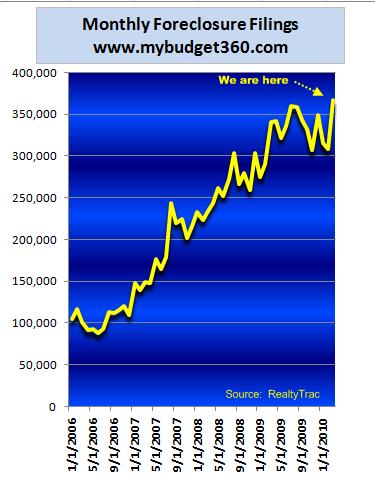
On the Day we Reach a Monthly Foreclosure Filing Record Banks Announce Record Profits and the Stock Market is up 80 Percent.

It is rather fitting that on the day we hear about banks reaching record profits once again, because after all it is so difficult to borrow at zero percent and gamble in the stock market and make a gain, that we also find out that March was the highest month of foreclosure filings ever (and we’ve had some bad months).  If there was ever a more clear indication between the split from Main Street and Wall Street this is probably the strongest indicator so far.  I’ll include the charts below but being blunt about the situation, the bailouts worked.  If we define “worked” as boosting banking profits once again while 40,000,000 Americans are on food stamps and 17 percent remain underemployed then all is well again in the economy.  Yet this isn’t what the American people bargained for in the bailouts.  In fact, they didn’t want the bailouts if you remember the massive anger from both aisles calling their representatives.  But the cronies didn’t listen since they receive millions in lobbying dollars and $13 trillion went to Wall Street in the biggest wealth transfer witnessed by the disgruntled American public.
It should be obvious the real economy is still a mess.  The latest foreclosure data is merely a reflection of failed government programs but more importantly, the absolute greed and robbery committed by Wall Street:


Just look at that chart.  We’ve had an 80 percent stock market rally in one year and today, we are at the peak of foreclosure filings.  That is, Americans getting kicked out of their homes because they are unable to pay their mortgages.  So much for banks using that money to help people stay in their homes and keeping the credit markets open as they preached.  JP Morgan announced stunning profits for the first quarter.  How did they make their money?
“(Yahoo!) NEW YORK – JPMorgan Chase & Co. reported a $3.3 billion first-quarter profit on big gains in the financial markets even as the Obama administration pressed for limits on banks’ trading of risky but lucrative investments.”
$3.3 billion is fantastic.  But how did they make that money?

Investment banking, especially bond trading, generated the bulk of JPMorgan’s profits. The bank said that division earned $2.5 billion, up 50 percent from a year earlier.”

So their gambling division made up the bulk of their profits.  How are they helping out consumers with those billions in taxpayer dollars?

“JPMorgan said it lost $1.3 billion on its real estate portfolios, slightly more than the $1.1 billion it lost the previous year. Signaling that it expects further credit weakness, the bank set aside $3.3 billion for real estate loan losses, up from $3.1 billion a year earlier.

The bank’s losses in its credit card business fell to $303 million, while provision for future credit card losses also dropped to $3.5 billion.”

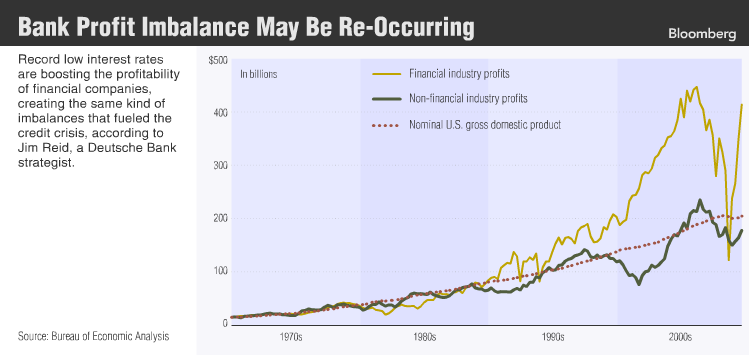
The formula is simple for these banks.  Use the taxpayer money to enrich their elite class under the guise of helping average Americans.  They have robbed the American people and much of this was all legal.  Yet we all know that there is something royally flawed in the financial system since it is the legislature that develops the laws and many are bought by the Wall Street crowd.  So this 80 percent stock market rally if we dissect it is being propelled by banks gambling:


Source:  Bloomberg

Notice how non-financials (i.e., the real economy) is only seeing a slight uptick in profits?  This probably has to do with 15 million unemployed Americans and another 9 million working part-time looking for full-time work.  But given there are 6 workers for every 1 job opening, things will be slow going.  Unless you are the corrupt banking sector.  In that case, you can borrow at zero percent and buy Treasuries, foreign currencies, stocks, or whatever it is and make money hand over fist while the real economy remains in the trough.  Why would you expect anything to be different?  We have yet to have one single piece of serious legislation hit the table for financial reform.  These banks are back to their same antics.

So what should be done?  Break the banks up.  Commercial banking should become more boring and what it once was, the lubricant to get the real economy going.  Right now it is merely a vampire sucking the blood out of the productive sectors.  Investment banking will be pushed to the edges and if banks want to gamble their own money then that is fine. 
But right now they are gambling taxpayer money trying to get back to even while shifting all the toxic credit out of their books.  Privatize gains and socialize losses.  With a system like that, is it any wonder the banks are back to record profits?

And you have to ask yourself how is it that banks while pushing a record number of foreclosure filings are back to record gains?  It is actually very simple.  They can shift the crap to taxpayers as they have through the FDIC, HAMP, suspension of mark to market, and other absurd gimmicks.  Then, they can use taxpayer money primarily funded through the Federal Reserve and U.S. Treasury and then gamble on the stock market.  But don’t be surprised when the market falls through again.  And why wouldn’t it?  The real economy isn’t really improving.  For $13 trillion we sure got bunk but add up the Wall Street market cap and profits and you can see what occurred.

It is a simple formula to understand.  And with no rules being changed, things are back to normal for the banks.  Too bad the other 95 percent of Americans are still dealing with the repercussions of the actual economy.

Let The Sun Shine In......

Thursday, April 8, 2010

A Woman With Good Oaklahoma Values Takes On Wall Street.....

....and we should all be cheering her on an voting against Republicans and Democrats that do not vote for the ordinary Joes and Josephines but, instead, play the cash game with the wealthiest of the very wealthy.

 
Share 

An Inside Outsider Takes On Wall Street

by: Jim Hightower, t r u t h o u t | Op-Ed


Wall Street banksters -- who could possibly love them?

OK, presumably their mommas do, and possibly their pet dogs, but that's it. The general public loathes them and would be delighted to see the whole bunch tarred, feathered and deported to a barren atoll, where their punishment would be living with themselves.

These preening, narcissistic elites turned America's financial system into a rigged casino game that paid off big-time for them. Then it crashed, wrecking our real economy and making life miserable for millions of people. Yet, there they are, still on their exalted thrones, still playing casino games (now with our bailout funds) and still lavishing obscene bonuses on themselves.

Despite their perfidy, they've not been made to pay any price by our public officials. Americans of all political stripes have watched in dismay as both Democratic and Republican leaders rushed to pat the hands and soothe the fevered brows not of us aggrieved parties, but of the banksters.

(Democrats at least publicly scolded the Wall Street chieftains, while such Republican bosses as Rep. John Boehner of Ohio and Sen. John Cornyn of Texas have turned public dismay into disgust by openly blowing kisses to the disgraced bankers. Boehner and Cornyn have been pledging that their party will keep fending off legislative restrictions on executive pay if Wall Street would only show a little return love in the form of more campaign cash for GOP coffers.)

Good grief, is there no sanity, no smidgen of integrity? Are no public officials on our side?
Meet Elizabeth Warren. She heads an independent agency that Congress set up in 2008 to monitor and report on the government bailout of Wall Street -- and the main thing you need to know about her is that the big-shots of finance despise her. Now that's refreshing!
Warren doesn't play the smooth insider game of Bohner, Cornyn, Timothy Geithner and Larry Summers. She doesn't because she's not a Wall Street insider. "Dang gummit," she says in her native Oklahoma twang, "somebody has got to stand up on behalf of middle-class families."

While she doesn't have the power to reform the Street's ingrained culture of greed, she can shine a light on it -- and she has been a fearless and tenacious griller of Gucci-clad bankers and weak-willed regulators. Her admiring husband describes her as a grandmother who can make grown men cry.

Coming from a working-class family, Warren knows first-hand what it is to face financial crisis (including foreclosure) and to feel the crushing power of uncaring banks. "I learned early on what debt means, how vulnerable it makes people," she told The New York Times last month. At age 16, she won a debate scholarship to college, then worked her way into law school and ultimately became a leading authority on bankruptcy.

Despite her success as a lawyer, she hasn't forgotten her populist roots and purpose. Warren is Wall Street's worst nightmare: a middle-class champion who gives a damn about workaday people, is smart and tenacious -- and can't be bought.

She is now bringing her background, legal expertise and moral outrage to bear on a proposal that she conceived and developed: a new agency with real regulatory teeth that would exist solely to protect consumers against banker deceit, scams and greed. Big bankers keel over in a dead faint at the very mention of Warren's proposal for a totally independent Consumer Financial Regulatory Agency, and they're lobbying ferociously to kill it ... and to demonize her.

However, the Wall Street reform package already passed by the House does include the independent CFPA she proposed. The Senate bill also includes a CFPA, but wimps out by putting it in the soft, banker-coddling hands of the Federal Reserve. The fight rages on, and its hard to have much faith that Washington would really go against Wall Street -- but Warren's a real fighter, and she has strong progressive supporters both inside and outside the Capital City.

She gives us someone to cheer for -- and to back. To join Elizabeth Warren's gutsy push on our behalf, contact the grass-roots coalition called Americans for Financial Reform: ourfinancialsecurity.org, (202) 263-4533.

National radio commentator, writer, public speaker, and author of the book, Swim Against The Current: Even A Dead Fish Can Go With The Flow, Jim Hightower has spent three decades battling the Powers That Be on behalf of the Powers That Ought To Be - consumers, working families, environmentalists, small businesses, and just-plain-folks.

All republished content that appears on Truthout has been obtained by permission or license.


Let The Sun Shine In......

Wednesday, April 7, 2010

Nobody should be too big to fail, so......

Robert Reich

Break Up The Banks


Monday, April 5, 2010
A fight is brewing in Washington – or, at the least, it ought to be brewing – over whether to put limits on the size of financial entities in order that none becomes “too big to fail” in a future financial crisis.

Some background: The big banks that got federal bailouts, as well as their supporters in the Administration and on the Hill, repeatedly say much of the cost of the giant taxpayer-funded bailout has already been repaid to the federal government by the banks that were bailed out. Hence, the actual cost of the bailout, they argue, is a small fraction of the $700 billion Congress appropriated.

True, but the apologists for the bailout leave out one gargantuan cost — the damage to the economy, which we’re still living with (witness the latest unemployment figures). Leave it to the Brits to calculate this. Andrew Haldane, Bank of England’s Financial Stability Director, figures the financial crisis brought on by irresponsible bankers and regulators has cost the world economy about $4 trillion so far.

So while the bailout itself is gradually being repaid (don’t hold your breath until AIG and GM repay, by the way), the cost of the failures that made the bailout necessary totals vast multiples of that.

Needless to say, the danger of an even bigger cost in coming years continues to grow because we still don’t have a new law to prevent what happened from happening again. In fact, now that they know for sure they’ll be bailed out, Wall Street banks – and those who lend to them or invest in them – have every incentive to take even bigger risks. In effect, taxpayers are implicitly subsidizing them to do so. (Haldane figures the value of that implicit subsidy to be about $60 billion a year for each big bank.)
Congress and the White House tell us not to worry because financial reform legislation will contain what’s called a “resolution” mechanism allowing regulators to wind down any big bank that gets into trouble. (Think bankruptcy with more safeguards against runs by bank by creditors wanting to get their money out right away.) By virtue of this resolution authority, they say, future bank creditors will have to price in the possibility of the bank being allowed to fail. Hence, the implicit subsidy for risk-taking will disappear. At least that’s the theory.
But the theory isn’t likely to work in practice. Do you really believe bank regulators will use the resolution authority — especially if two or more giant banks are endangered at the same time? Multiple threats are almost certain because each big bank races to copy any gambling technique that pays off big for any other. The reality is, they’ll get bailed out.
Even if the resolution authority were combined with an array of new regulations designed to cover all the “shadow banking” operations of the giant banks — requiring that they put up more capital and thereby limit their leverage – there’s no way such regulations can succeed. The giant banks already hire fleets of lawyers, accountants, and financial entrepreneurs to find loopholes in every existing regulation.
Finally, consider the political power of the big Wall Street banks. They and their executives and employees are now among the biggest contributors to both parties. Wall Street lobbyists are crawling over Capitol Hill. The banks and their lobbyists will ensure that regulatory loopholes are built into regulations from the start. Remember: They dismembered Glass-Steagall (with the help of their friends in the Fed, on the Hill, and in the Clinton White House), and fought off derivative regulation (ditto).
As long as the big banks are allowed to remain big, their political leverage over Washington will remain big.  And as long as their political leverage remains big, the taxpayer and economic tab for the next mess they create will be big.
By all means, give regulators resolution authority and also impose the tightest regulations possible. But Congress and the White House shouldn’t stop there. Limits should be placed on how big big banks can become.
How big? No one has been able to show significiant efficiencies over $100 billion in assets. Make that the outside limit.
To be sure, smaller banks might still be subject to runs. That’s why the Federal Deposit Insurance Corporation was created in the 1930s – to ensure depositors in the event a bank gets into trouble, so they won’t have to run to protect their savings. And why the Glass-Steagall Act was passed – to separate commercial banking (where depositors put their money) from investment banking (where betting is done). We could expand insurance to certain categories of bank creditor, and we should resurrect Glass-Stagall.
But the only way to make sure no bank it too big to fail is to make sure no bank is too big. If Congress and the White House fail to do this, you have every reason to believe it’s because Wall Street has paid them not to.


Let The Sun Shine In......

Thursday, April 1, 2010

Wall Street Got $4.6 Trillion of our money

This news release was distributed by the Center for Media and Democracy in Madison, Wisconsin.

CMD RELEASES NEW WALL STREET BAILOUT TOTAL $4.6 TRILLION IN FEDERAL FUNDS DISBURSED New Tally Focuses on Expansive Role of Federal Reserve

Today, the Real Economy Project of the Center for Media and Democracy (CMD) released an assessment of the total cost to taxpayers of the Wall Street bailout. CMD concludes that multiple federal agencies have disbursed $4.6 trillion dollars in supporting the financial sector since the meltdown in 2007-2008. Of that, $2 trillion is still outstanding.
CMD's assessment demonstrates that the Federal Reserve has provided by far the bulk of the funding for the bailout in the form of loans amounting to $3.8 trillion. Little information has been disclosed about what collateral taxpayers have received in return for these loans. CMD also concludes that the bailout is far from over as the government has active programs authorized to cost up to $2.9 trillion and still has $2 trillion in outstanding investments and loans.

Learn more about the 35 programs included in our tally by visiting our Total Wall Street Bailout Cost Table, which contains links to pages on each bailout program with details including the current balance sheet for each program.

"While the Treasury Department is patting itself on the back for recouping Troubled Asset Relief Program (TARP) funds and allegedly making money off of its aid to Citigroup, our accounting shows that these programs were a relatively small portion of the federal funds that have gone out the door in support of the financial sector. Far more has been done to aid Wall Street through the back door of the Federal Reserve than through the front door of Congressional appropriations," said Mary Bottari, Director of CMD's Real Economy Project.

"The tally shows that more scrutiny needs to be given by policymakers and the media to the role of the Federal Reserve especially as the Fed has accounted for the vast majority of the bailout funds, yet provides far less disclosure and is far less directly accountable than the Treasury," said Conor Kenny, the researcher who collected the data on the bailout.

CMD has presented its work in a table that shows: funds disbursed, maximum funds that were at-risk at the height of the bailout, and actual funds still outstanding for each program. CMD is also making available a Financial Crisis Tracker, a widget for the table that can be downloaded to websites to get up-to-date numbers on the financial crisis and the bailout. The Wall Street Bailout table will be updated monthly and will be a tremendous resource for reporters and the public alike.

Let The Sun Shine In......