Showing posts with label CFPA. Show all posts

Thursday, April 8, 2010

A Woman With Good Oaklahoma Values Takes On Wall Street.....

....and we should all be cheering her on an voting against Republicans and Democrats that do not vote for the ordinary Joes and Josephines but, instead, play the cash game with the wealthiest of the very wealthy.

 
Share 

An Inside Outsider Takes On Wall Street

by: Jim Hightower, t r u t h o u t | Op-Ed

Wall Street banksters -- who could possibly love them?

OK, presumably their mommas do, and possibly their pet dogs, but that's it. The general public loathes them and would be delighted to see the whole bunch tarred, feathered and deported to a barren atoll, where their punishment would be living with themselves.

These preening, narcissistic elites turned America's financial system into a rigged casino game that paid off big-time for them. Then it crashed, wrecking our real economy and making life miserable for millions of people. Yet, there they are, still on their exalted thrones, still playing casino games (now with our bailout funds) and still lavishing obscene bonuses on themselves.

Despite their perfidy, they've not been made to pay any price by our public officials. Americans of all political stripes have watched in dismay as both Democratic and Republican leaders rushed to pat the hands and soothe the fevered brows not of us aggrieved parties, but of the banksters.

(Democrats at least publicly scolded the Wall Street chieftains, while such Republican bosses as Rep. John Boehner of Ohio and Sen. John Cornyn of Texas have turned public dismay into disgust by openly blowing kisses to the disgraced bankers. Boehner and Cornyn have been pledging that their party will keep fending off legislative restrictions on executive pay if Wall Street would only show a little return love in the form of more campaign cash for GOP coffers.)

Good grief, is there no sanity, no smidgen of integrity? Are no public officials on our side?
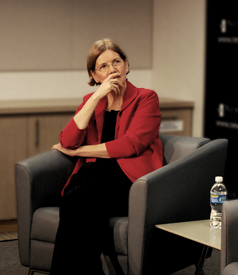
Meet Elizabeth Warren. She heads an independent agency that Congress set up in 2008 to monitor and report on the government bailout of Wall Street -- and the main thing you need to know about her is that the big-shots of finance despise her. Now that's refreshing!
Warren doesn't play the smooth insider game of Bohner, Cornyn, Timothy Geithner and Larry Summers. She doesn't because she's not a Wall Street insider. "Dang gummit," she says in her native Oklahoma twang, "somebody has got to stand up on behalf of middle-class families."

While she doesn't have the power to reform the Street's ingrained culture of greed, she can shine a light on it -- and she has been a fearless and tenacious griller of Gucci-clad bankers and weak-willed regulators. Her admiring husband describes her as a grandmother who can make grown men cry.

Coming from a working-class family, Warren knows first-hand what it is to face financial crisis (including foreclosure) and to feel the crushing power of uncaring banks. "I learned early on what debt means, how vulnerable it makes people," she told The New York Times last month. At age 16, she won a debate scholarship to college, then worked her way into law school and ultimately became a leading authority on bankruptcy.

Despite her success as a lawyer, she hasn't forgotten her populist roots and purpose. Warren is Wall Street's worst nightmare: a middle-class champion who gives a damn about workaday people, is smart and tenacious -- and can't be bought.

She is now bringing her background, legal expertise and moral outrage to bear on a proposal that she conceived and developed: a new agency with real regulatory teeth that would exist solely to protect consumers against banker deceit, scams and greed. Big bankers keel over in a dead faint at the very mention of Warren's proposal for a totally independent Consumer Financial Regulatory Agency, and they're lobbying ferociously to kill it ... and to demonize her.

However, the Wall Street reform package already passed by the House does include the independent CFPA she proposed. The Senate bill also includes a CFPA, but wimps out by putting it in the soft, banker-coddling hands of the Federal Reserve. The fight rages on, and its hard to have much faith that Washington would really go against Wall Street -- but Warren's a real fighter, and she has strong progressive supporters both inside and outside the Capital City.

She gives us someone to cheer for -- and to back. To join Elizabeth Warren's gutsy push on our behalf, contact the grass-roots coalition called Americans for Financial Reform: ourfinancialsecurity.org, (202) 263-4533.

National radio commentator, writer, public speaker, and author of the book, Swim Against The Current: Even A Dead Fish Can Go With The Flow, Jim Hightower has spent three decades battling the Powers That Be on behalf of the Powers That Ought To Be - consumers, working families, environmentalists, small businesses, and just-plain-folks.

All republished content that appears on Truthout has been obtained by permission or license.


Let The Sun Shine In......

Thursday, March 18, 2010

Accounting Fraud Continues to Plague U.S. Economy


By Zach Carter, Media Consortium blogger              Care2

Senate Banking Committee Chairman Chris Dodd (D-CT) unveiled his latest financial reform proposal on Monday, and the stakes for the new legislation couldn’t be higher. After consumer groups raised a major ruckus, Dodd has dropped one of his most egregious concessions to the bank lobby—cutting enforcement authority from the proposed Consumer Financial Protection Agency (CFPA). That’s good news: Without a major regulatory overhaul, the U.S. economy’s destructive boom and bust cycle will start all over again.

We’ve been down this road before. The Enron fiasco should have served as a wake-up call for policymakers, but instead, the weak federal response to Enron’s major fraud helped pave the way for the current economic slump.


What does Enron have to do with the crisis?

As Megan Carpentier emphasizes for The Washington Independent, one of the key “reforms” Congress enacted in the Enron aftermath was a law requiring every CEO to sign-off on their company’s accounting statements—but it has accomplished almost nothing.

Enron collapsed due to accounting fraud. Its executives weren’t stupid or careless—they made their money by engaging in deliberate and coordinated acts of illegal deception. But CEOs of companies like Enron had always been able to deny that they knew about the shenanigans that were playing out in their accounting departments. By forcing CEOs to sign off on their accounting statements, Congress was attempting to “deny them plausible deniability,” as Carpentier puts it.

But accounting fraud has plagued the U.S. economy, even after the Enron scandal. It also plays a major role in the Wall Street crisis. A recent court report from Lehman Brothers’ bankruptcy examiner reveals that the company arranged a series of complicated transactions to hide $50 billion in debt, making Lehman appear healthier than it was. By hiding this debt, Lehman was able to make bigger bets on the mortgage market. The defense issued by Lehman CEO Richard Fuld? He apparently didn’t know the accounting hijinks were happening


An epidemic of fraud

Most U.S. policymakers are still having a hard time coming to grips with the fact that our financial system is rife with fraud at almost every level. Writing for AlterNet, Joe Costello reports on a recent Roosevelt Institute conference featuring several major economic luminaries. Costello argues that some of Wall Street’s biggest problems were driven by run-of-the-mill fraud. And a key vehicle for this fraud, Costello notes, was the derivatives market—the same market that allowed Enron to perpetrate its own frauds. Many of the scams aren’t even particularly new or creative. They’re simply the same cons that helped usher in the Great Depression.

“If we’re going to get our economy up and running again, the first thing we’re going to have to do is end the fraud,” Costello writes.


Protecting Whistleblowers

But astonishingly, even after the worst financial crisis in history, bigwig bankers have been able to avoid fraud charges and investigations. Even when the Justice Department went after Swiss banking Giant UBS for a massive tax evasion scheme, they let the company’s U.S. executives off the hook and instead jailed the very whistleblower who told the government about the fraud.

The whistleblower, Bradley Birkenfeld, is by no means innocent of wrongdoing—he even smuggled diamonds in a toothpaste container for a wealthy UBS client. But as Corbin Hiarr notes for Mother Jones, jailing the man who blows the whistle sends exactly the wrong message to anybody in Big Finance who recognizes a problem. Not only will your employer come at you with everything it has, but the government you aid will actually send you to prison. The fraudsters you finger get to retire to the Caymans.

This is part of the reason that successful financial reform is not just what the rules are, but who gets to enforce them. There were many reasonable rules against predatory lending that bank regulators at the Federal Reserve and the Office of the Comptroller of the Currency (OCC) could have used to thwart the financial crisis early on, but neither agency was interested in doing so. They were more concerned with short-term banking profits, and up until 2007, sketchy accounting was allowing banks to book big gains on the subprime market.


Why we need a CFPA

That’s why all the way back in June of 2009, President Barack Obama proposed establishing a CFPA focused exclusively on defending consumers against banks. With no concerns for bank profitability, CFPA regulators could go after unfair practices and fraud because they were wrong, regardless of what they did for bank balance sheets.

The proposal was watered down significantly in the House, as Kai Wright notes for The Nation, and just a week ago it appeared that Dodd was ready to completely torpedo the new regulator in an effort to craft bipartisan support for a so-called “reform” bill.

He’s backed off since then, but without strong enforcement authority, nothing is gained—the same corrupt regulators will simply continue to look the other way. But Dodd would still house the new agency at the Federal Reserve. Dodd insists the Fed would have no authority over the CPFA, but if that were the case, why would he introduce the provision at all?

“Reform in name alone will be useless to both consumers and politicians,” writes Wright.

Strong financial reform is overwhelmingly popular. While it’s good to see Dodd backing away from some of the gifts he’d previously proposed to bank lobbyists, progressives must keep the pressure high to ensure that financial reform is strengthened as it moves through the Senate.

It’s easy for a corrupt lawmaker to vote against a weak bill: He can always plead that the bill wasn’t good enough and be right. But serious, popular reform is not so easy to oppose. If Dodd and the Democratic leadership make the politicians backed by the bank lobby—that’s literally every Republican, plus a handful of conservative Democrats—stand up and vote against a good bill, many of them will have to choose between their lobbyist friends and their political future.
 
This post features links to the best independent, progressive reporting about the economy by members of The Media Consortium. It is free to reprint.


Let The Sun Shine In......

Tuesday, March 9, 2010

Is It Doomsday for the Consumer Financial Protection Agency?

And I thought that Dodd was on our side.

Whiskey Tango Foxtrot?


by Alison Hamm, Media Consortium Blogger

Just when the Democrats need to be tougher than ever on financial reform, Senate Banking Committee Chair Sen. Chris Dodd (D-CT), seems to have given up completely and put the proposed Consumer Financial Protection Agency (CFPA) at risk.

Last fall, Dodd called the Federal Reserve's regulatory efforts an "abysmal failure." And yet, on March 1, he proposed housing a consumer protection agency within the Fed instead of establishing the CFPA as its own independent entity. This drastic change in strategy has left many Democrats shaking their heads. WTF, Senator Dodd?


A change in focus
As Andy Kroll reports for Mother Jones:

Dodd appears to have switched his focus from out-reforming the White House to out-compromising just about everyone. As the Senate banking committee prepares to release a draft of a comprehensive reform bill as early as this week, Dodd has repeatedly conceded to his Republican counterparts on key issues, almost guaranteeing that the Senate's measure will be far more lenient on the banking industry than the legislation the House passed in December...

Dodd's willingness to appease Republicans like Sen. Bob Corker (R-Tenn.), the main GOP negotiating partner, and Sen. Richard Shelby (R-Ala.), the banking committee's ranking member, has disappointed Dodd's fellow Democrats and reform advocates who urge a tougher crackdown.


Whither the CFPA?

Dodd's latest GOP compromise is part of a bigger problem: The Democrats have mishandled financial reform. As Nomi Prins writes for AlterNet, "Dodd's latest effort at creating a new Consumer Financial Protection Agency would render the regulator utterly powerless, but it's not the only issue Democrats appear willing to sacrifice to Wall Street campaign contributions. Right now, just about every other major element of the so-called Wall Street overhaul seems headed for disaster."

Although the establishment of the CFPA has been fiercely opposed by the banks and Republicans, it has widespread approval among progressives and the general public. So why has Dodd apparently abandoned it through compromise? Maybe because he's following the lead of his fellow Democrats. Prins notes: "Since June, we've been waiting to see whether Democrats had the spine to make sure the final agency would actually do something, or quietly gut reform with a barrage of loopholes."

There's still time for Dodd to push real reform before he retires. Or, like Prin says, he could "continue to wimp out for Wall Street, pull a Robert Rubin and secure a cushy job in banking come 2011. The next few months will indicate whether Dodd cares more about his legacy than his wallet."
 

Solis a 'bright spot'

But maybe there is hope. Department of Labor Secretary Hilda Solis has made considerable progress, as Mark Engler emphasizes for Yes! magazine. Engler calls Obama's Labor appointment a "bright spot" in the administration's first year—a move "that illustrate[s] the difference that a progressive-minded administration can make when it stands up to corporate interests and is unafraid to act in the public good."
Engler writes:

Under the Bush administration’s Department of Labor, the crisis of wage theft was summarily ignored. In March 2009, the Government Accountability Office issued a report saying that the department’s Wage and Hour Division had for years 'left thousands of actual victims of wage theft who sought federal government assistance with nowhere to turn.' Secretary Solis made reversing this trend a defining initiative of her department. Even before the report had been released, she had commenced the hiring of 150 new field investigators to enforce wage and child labor laws, as well as 100 more to police government contractors working on stimulus programs.

As Engler argues, officials would do well to follow the lead of Secretary Solis and demonstrate "what can be accomplished when regulators are encouraged to actually do their jobs—to fight for the interests of workers, for example — vigorously and creatively."


Buffet on banking

Finally, GRITtv's Laura Flanders reviews Warren Buffet's annual letter to shareholders, in which Buffet warns his clients that their financial advisers’ advice is skewed by the financial system. As Flanders notes:

Ironically, just as Buffett's letter was being published, the man it'll take to make any agency happen -- Christopher Dodd -- is agreeing to defang the agency, strip it of independence and most prosecution power.


IN ACCORDANCE WITH TITLE 17 U.S.C. SECTION 107, THIS MATERIAL IS DISTRIBUTED WITHOUT PROFIT TO THOSE WHO HAVE EXPRESSED A PRIOR INTEREST IN RECEIVING THE INCLUDED INFORMATION FOR RESEARCH AND EDUCATIONAL PURPOSES. PELICAN BLOGS HAS NO AFFILIATION WHATSOEVER WITH THE ORIGINATOR OF THIS ARTICLE NOR ARE PELICAN BLOGS ENDORSED OR SPONSORED BY THE ORIGINATOR.

"VIEW SOURCE ARTICLE" LINKS ARE PROVIDED AS A CONVENIENCE TO OUR READERS AND ALLOW FOR VERIFICATION OF AUTHENTICITY. HOWEVER, AS ORIGINATING PAGES ARE OFTEN UPDATED BY THEIR ORIGINATING HOST SITES, THE VERSIONS POSTED ON THIS BLOG MAY NOT MATCH THE VERSIONS OUR READERS VIEW WHEN CLICKING THE "VIEW SOURCE ARTICLE" LINKS.

Let The Sun Shine In......